
Insights
Differences Between Steel Fabrication and Sheet Metal Fabrication | Which to Entrust with Frame Structures
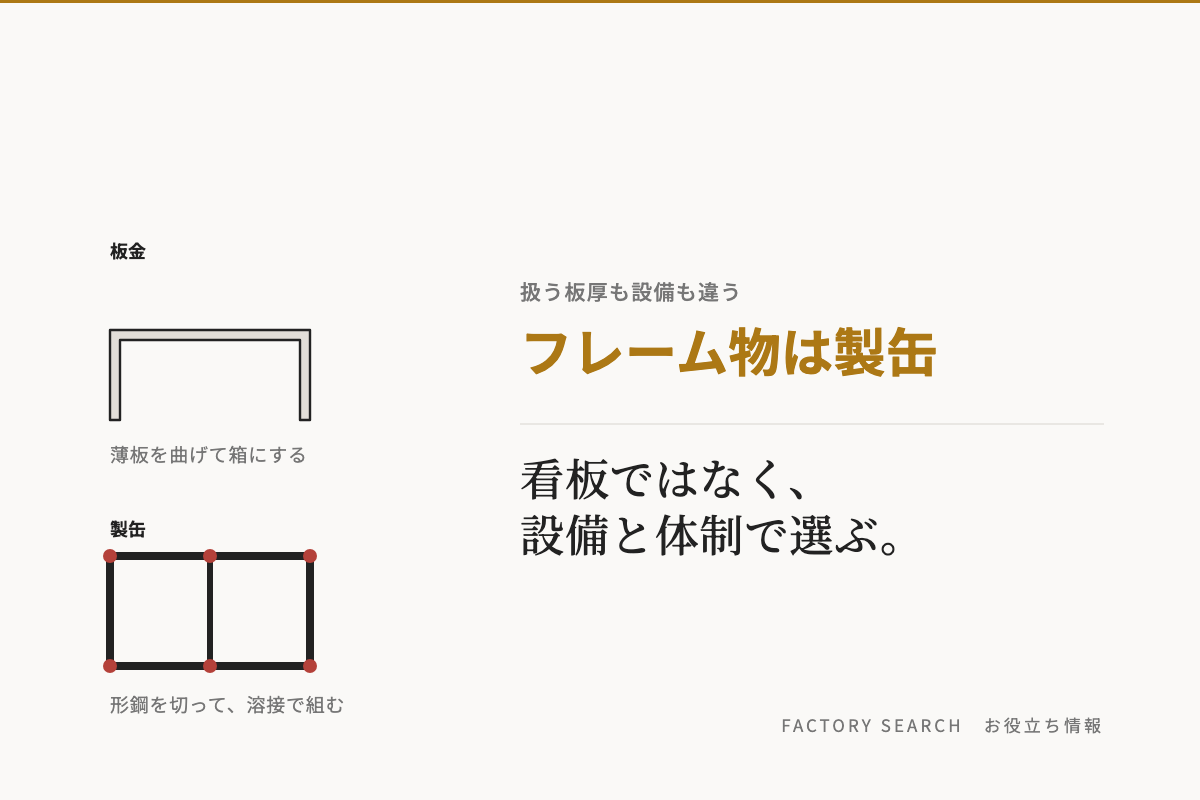
"Steel fabrication" and "sheet metal fabrication" both involve processing iron into shape. Both are often listed in company profiles, making it difficult for those seeking outsourcing partners to discern the differences. However, it actually happens that a company specializing in sheet metal fabrication will refuse orders for frame structures made from structural steel. We will clarify what the differences are and which type of company you should entrust your project to.
Conclusion: Differences in Plate Thickness Handled and Assembly Methods
Roughly speaking, sheet metal fabrication involves bending thin plates to form boxes, while steel fabrication involves cutting thick materials and assembling them by welding. The boundary is a gradient, with no clear demarcation. However, since the equipment and processes differ, their areas of expertise diverge.
| Sheet Metal Fabrication | Steel Fabrication | |
|---|---|---|
| Main materials handled | Thin steel plates | Thick plates, structural steel (angle steel, channel steel) |
| Primary forming method | Bending (press brake) | Cutting and welding |
| Main equipment | Turret punch press, laser, bender | Ironworker, large laser, welding equipment |
| Products made | Covers, chassis, outer panels, control panel boxes | Frames, stands, underframes, large structures |
| How accuracy is achieved | Through development and bending sequence | Through cutting dimensions, assembly sequence, and distortion removal |
| Required space | Relatively compact | Space needed to place assembled structures |
Which to Entrust with Frame Structures
If it's a frame or stand using angle steel or channel steel, it's steel fabrication. There are three reasons.
1. Different Equipment for Cutting Structural Steel
While steel plates are mainly cut by laser or turret punch, structural steel requires specialized machines like ironworkers, or large lasers capable of cutting structural steel. These may not be available at factories primarily focused on sheet metal fabrication.
2. Different Methods for Achieving Accuracy
Sheet metal fabrication achieves accuracy through development drawings and bending sequences. In contrast, structural steel frames achieve accuracy through cutting dimensions that account for material variations, assembly sequence, and final distortion removal. The underlying approach is fundamentally different.
This difference is discussed in detail in "How much dimensional tolerance does structural steel have?" and "Mechanism of welding distortion."
3. Different Number of Personnel Involved in Welding
Frame structures involve a large amount of welding, requiring more personnel and space as they get larger. The number of employees involved in welding and their familiarity with handling structural steel directly translates to the company's capability. In fact, some companies disclose a system where about half of their employees are involved in welding, and most of them are accustomed to handling structural steel.
There are cases where a company calling itself a "sheet metal shop" is strong in steel fabrication
This is a tricky point when searching for an outsourcing partner. Company names are often based on historical circumstances, and the name on the sign may not match the actual capabilities. It is not uncommon for companies to call themselves "sheet metal" shops while their organizational structure leans towards steel fabrication.
Do not judge by the name; check the following.
Questions to discern actual capabilities
- Do they regularly handle structural steel (angle steel, channel steel)? What are their preferred sizes?
- What equipment do they use to cut structural steel?
- How many people are involved in welding? What percentage of the total workforce?
- Do they have enough space to check accuracy while assembled?
- Do they have a final distortion removal process?
- What is the maximum dimension of frames they have produced in the past?
Situations where both are required
In actual products, both technologies are almost always required. For example, in a control panel enclosure, the frame is steel fabrication, while the outer panels and doors are sheet metal fabrication. Therefore, if you want to entrust the entire enclosure to one company, you will need to look for a company that possesses both types of equipment.
For the structure of enclosures, please refer to "Introduction to Cubicle Enclosure Structures."
Summary
- Sheet metal fabrication involves bending thin plates to form boxes; steel fabrication involves cutting thick plates and structural steel and assembling them by welding.
- Frame structures and stands using structural steel fall under steel fabrication.
- Equipment for cutting structural steel, the number of welders, and space for assembled structures determine capability.
- Company names may not always match actual capabilities. Judge based on equipment and organizational structure.
- For control panel enclosures, the frame is steel fabrication, and the outer panels and doors are sheet metal fabrication. Both are required.
Frequently Asked Questions
- Q. From what plate thickness does it become steel fabrication?
- A. There is no clear boundary. It depends on each company's equipment capabilities. It is more practical to consider the manufacturing method—whether it's "bending to create" or "cutting and welding to assemble"—rather than just plate thickness.
- Q. Are "welded structures" and "steel fabrication" the same thing?
- A. They largely overlap. The term "steel fabrication" originally comes from making cans (tanks), and now refers to the general process of assembling thick plates and structural steel by welding.
- Q. If a drawing is prepared with sheet metal fabrication in mind, can it be directly used for steel fabrication?
- A. It can be used, but if the manufacturing method changes, the optimal shape will also change. Trying to assemble structural steel directly from a development drawing based on bending may lead to difficulties, so please consult with the manufacturer at an early stage.
- Q. Is it better to consolidate with one company?
- A. If the combination requires accuracy, consolidating with one company is advantageous. If the frame and outer panels are produced separately, the responsibility for mating surfaces becomes ambiguous, and there will be no single point for fitment adjustments.
Related articles
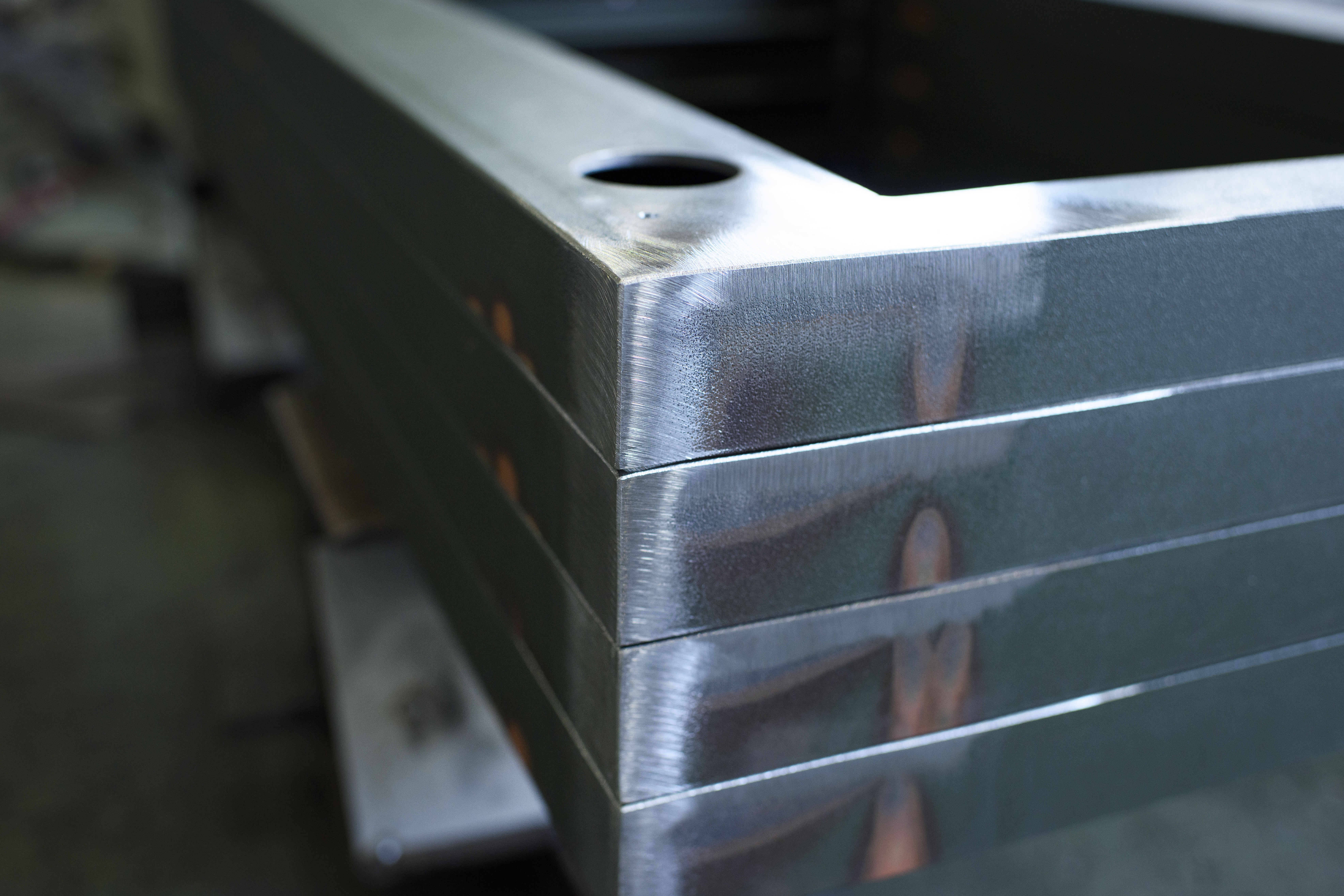
Industrial Angle Frame Manufacturing
Manufacturing of angle frames and stands for distribution boards and cubicle enclosures. E…