
Insights
Mechanism of Welding Distortion and Assembly Sequence/Distortion Removal for Large Frames
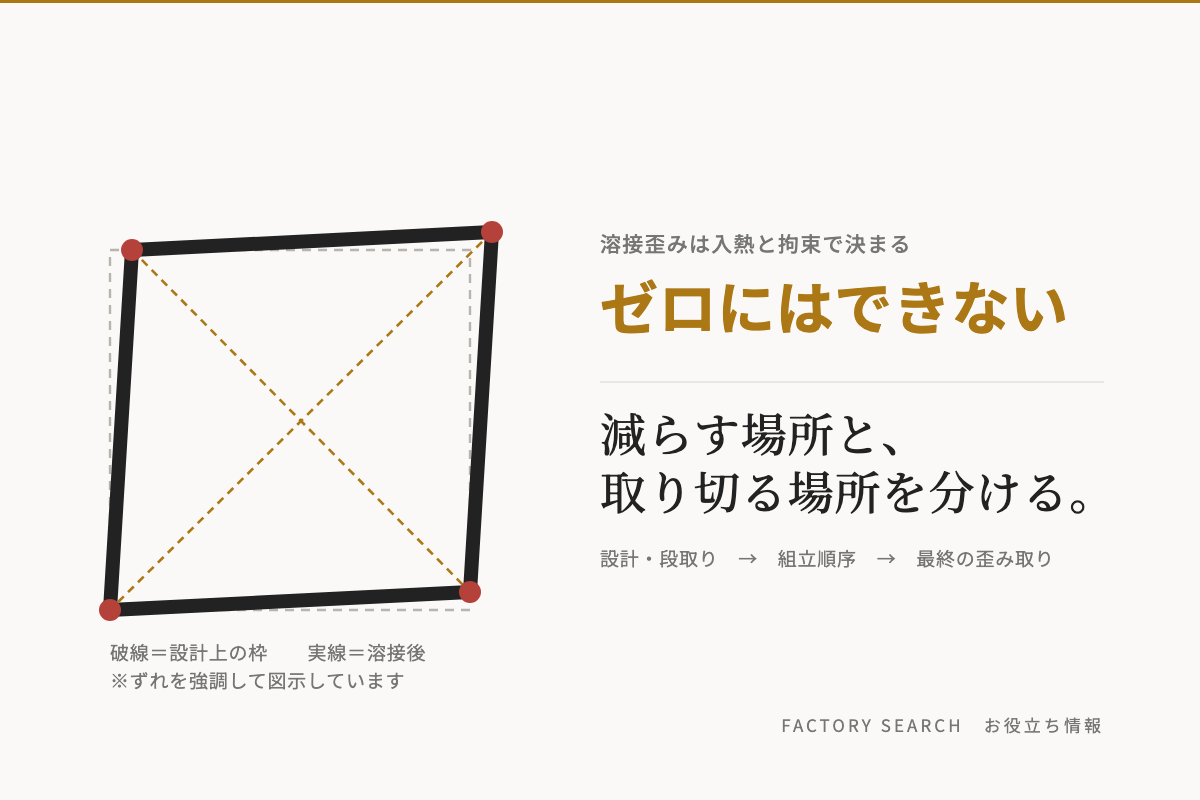
"It warped after welding," "The diagonal didn't align when assembled into a box." Welding distortion is physically inevitable, regardless of skill. It cannot be eliminated. Therefore, at the site, we consider "measures to prevent distortion" and "processes to remove existing distortion" separately. This article organizes how distortion occurs in large frames, where to suppress it, and how to finish it in the end.
Conclusion: Distortion Cannot Be Eliminated. Separate Where to Reduce and Where to Remove
Welding is a process of melting and cooling a part of the material. The melted part shrinks when it cools, but it is restrained by the surrounding base material and cannot shrink freely. This difference between the "desired shrinkage" and the "actual shrinkage" remains as residual stress, manifesting as angular deformation, bending, and twisting.
Therefore, countermeasures are divided into three areas: reducing the amount of distortion through design and preparation, reducing bias through assembly sequence, and removing the remaining distortion in the final process. None of these alone is sufficient.

Types of Distortion Common in Large Frames
| Type | How it Appears | Where it Affects |
|---|---|---|
| Angular Deformation | Plate bends at the weld line | Flatness of flange surface, door fitting |
| Transverse Shrinkage | Shrinks perpendicular to the weld line | Frame outer dimensions, hole pitch |
| Longitudinal Shrinkage | Shrinks along the weld line | Overall length of long materials |
| Bending (Warping) | Becomes bowed if welding is biased to one side | Channel base, long girders |
| Twisting | Twists diagonally | Frame diagonal dimension |
Bending and twisting are common problems in structural steel frames. This is because angle steel has an asymmetrical cross-section, making it easy for welding positions to be biased to one side. Especially with longer materials, even slight angular deformation can result in significant runout at the ends.
Reducing the Amount of Distortion
Reducing the Welding Volume Itself
Distortion increases proportionally with heat input. Fillet welds with excessively large leg lengths do not contribute to strength but only increase distortion. Whether continuous welding can be changed to intermittent welding is also a consideration at the design stage.
Arranging Symmetrically
If the weld line is biased to one side, only that side will shrink and bend. If arranged symmetrically on the left/right and front/back, shrinkage will cancel out. If symmetry cannot be achieved in the design, compensate with the welding sequence.
Using Restraint (But Not a Panacea)
Deformation can be suppressed by firmly holding with a jig, but that amount remains internally as residual stress. When the restraint is removed, or during subsequent processes like drilling or plating, the stress may be released, causing movement. Simply holding it down does not solve the problem.
Reducing Bias with Assembly Sequence
Even with the same parts and welding volume, the results vary depending on the welding sequence. The basic idea is to "allow distortion to escape in a low-restraint state, and finally define the reference plane."
- Weld from the center outwards (if proceeding from one end, shrinkage accumulates in one direction)
- Weld diagonally (do not weld one side continuously)
- Determine the shape with tack welding before proceeding to full welding
- Determine the relationship between the main body and the base first (if you try to align them later, there's no room for adjustment)
For frames that will be arranged in a row, this sequence directly impacts overall length accuracy. In an actual example where errors are absorbed in four processes: cutting accuracy, hole position, assembly sequence, and final distortion removal, the assembly sequence is included as a design item, defined as "the sequence that prevents cumulative errors."
Accuracy is Determined by Final Distortion Removal
Even after all these steps, distortion will remain. The product's accuracy is determined by whether there is a final process to remove it completely.
Items to Finish with Distortion Removal
- Angle: Is the frame square?
- Diagonal: Is it not skewed into a parallelogram?
- Overall Length: Through dimension when arranged in a row
- Flatness: Does it not float when the outer panel is attached?
If only the outer dimensions and hole pitch are inspected before shipment, the frame may be delivered with skewed diagonals. This may not be noticed when inspecting individual units, but the problem surfaces as the overall length not matching when arranged in a row.
What Buyers Should Confirm
| What to Confirm | Why |
|---|---|
| Do they have a distortion removal process? | Without it, material and welding variations will directly affect the product. |
| What do they inspect (do they check diagonals and angles)? | Inspecting only outer dimensions and holes can result in skewed frames passing. |
| Is there enough space to check accuracy while assembled? | For large frames, measuring in segments can hide cumulative errors. |
| Is it assumed to move due to heat from post-processes (plating/painting)? | Hot-dip galvanizing involves immersion in a high-temperature bath, which can release residual stress and cause movement. |
Summary
- Welding distortion inevitably arises from heat input and restraint. It cannot be eliminated.
- Countermeasures are in three areas: "reducing in design/preparation," "reducing bias in assembly sequence," and "removing completely in the final stage."
- The amount suppressed by restraint remains as residual stress and may cause movement in subsequent processes.
- Bending and twisting are common in structural steel frames because their cross-sections are asymmetrical, leading to biased welding.
- Final distortion removal finishes angles, diagonals, overall length, and flatness. The presence or absence of this process determines accuracy.
Frequently Asked Questions
- Q. If the welding skill is good, will distortion not occur?
- A. It will occur. Distortion is a physical phenomenon determined by heat input and restraint. What skill affects is the "variation in the amount of distortion" and the "accuracy of complete removal," but its occurrence itself cannot be avoided.
- Q. Can annealing remove it?
- A. Stress relief annealing can reduce residual stress, but large frames often do not fit into furnaces, and it incurs significant cost and lead time. At steel fabrication sites, it is common to finish with assembly sequence and mechanical distortion removal.
- Q. It came back bent after plating.
- A. Hot-dip galvanizing involves immersion in a high-temperature bath, which can release residual stress and cause movement. For production intended for plating, the design of the sequence and restraint must account for this. Please also confirm in advance if they can handle rework after plating.
- Q. How much should be written on the drawing?
- A. Specifying the permissible values for flatness, perpendicularity, and diagonals, and which of these to prioritize, allows the manufacturer to determine the optimal approach for distortion removal. Not everything can be prioritized.
Related articles
Industrial Angle Frame Manufacturing
Manufacturing of angle frames and stands for distribution boards and cubicle enclosures. E…