
Insights
What is Angle Steel (Angle Bar)? | Differences between Equal and Unequal Angles and How to Read JIS Size Charts
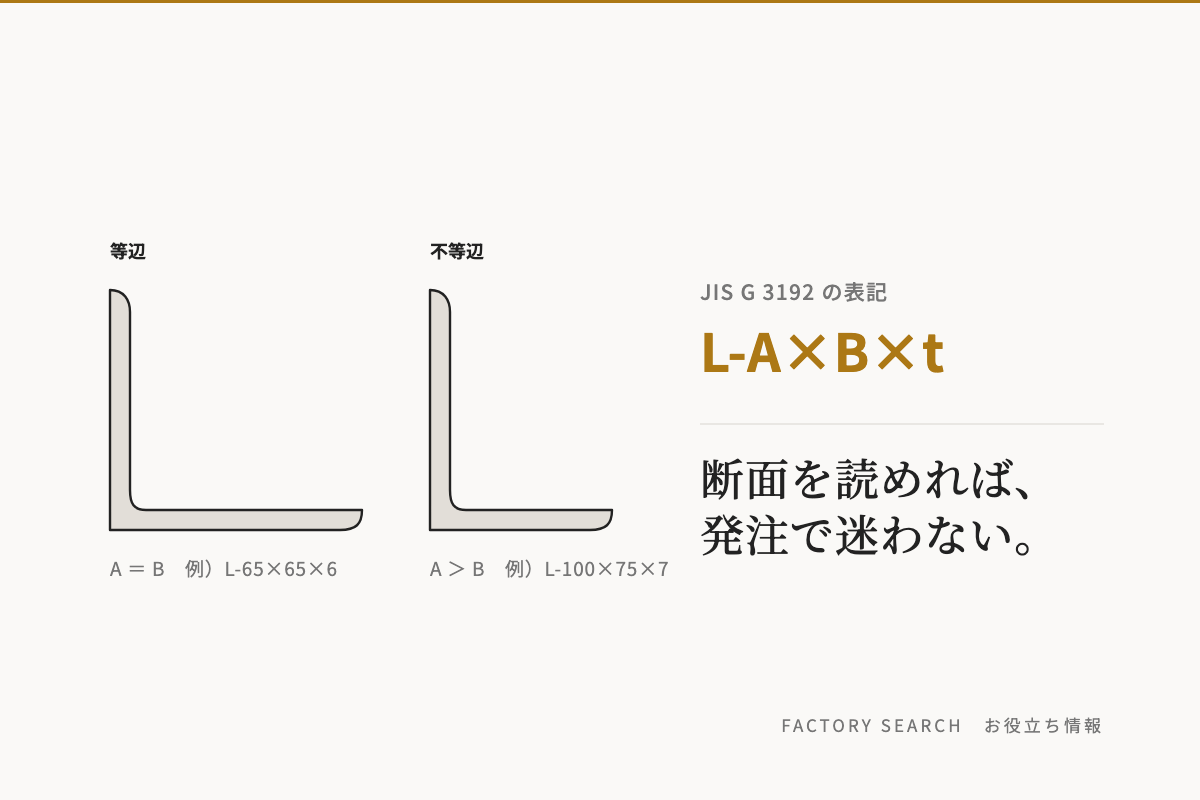
Angle steel is a structural steel with an L-shaped cross-section. Also known as "angle bar," it is most commonly used as a frame material for control panel enclosures and stands. However, when it comes to ordering, it's easy to get confused about "what the numbers in L-65×65×6 refer to" or "how to differentiate between equal and unequal angles." This article organizes everything from how to read the JIS G 3192 notation to practical tips for selection.
Conclusion: Notation is "Side A × Side B × Thickness t"
Angle steel is designated as L-A×B×t. For L-65×65×6, the side lengths are 65mm and 65mm, and the plate thickness is 6mm. All units are in mm. If A and B are the same, it's called equal angle steel; if different, it's unequal angle steel.

Note that the order of notation may vary by company or drawing, with the plate thickness sometimes written first, such as "6×65×65". While it's often possible to determine by the magnitude of the numbers, if in doubt, please confirm with your buyer.
Distinguishing Between Equal and Unequal Angles
| Equal Angle Steel | Unequal Angle Steel | |
|---|---|---|
| Cross-section | A = B | A > B |
| Main Applications | General framing. Parts where force is applied equally from all directions. | Parts requiring strength in one direction, or where a wider mounting surface is desired. |
| Availability | Abundant in sizes and stock | Fewer types than equal angles |
| Example in Control Panels | L-65×65×6 (Mainstay for enclosure frames) | L-100×75×7 (Large frame) |
If in doubt, start with equal angles. Unequal angles are chosen when there's a reason like "wanting to receive other components on a wider surface" or "load is applied only to one side." If you simply need strength, increasing the size of an equal angle is easier for procurement.
Guidelines for Size and Plate Thickness
Based on the standard sizes of JIS G 3192, the applications as frame material can be summarized as follows:
| Side × Side | Thickness t | Main Applications |
|---|---|---|
| 25×25 / 30×30 / 40×40 | 3 〜 5 | Small frames / Reinforcement materials |
| 45×45 / 50×50 | 4 〜 6 | Small frames |
| 60×60 / 65×65 | 4 〜 8 | Mainstay for control panel enclosures (L-65×65×6) |
| 70×70 / 75×75 / 80×80 | 6 〜 12 | Medium frames / Stands |
| 90×90 / 100×100 | 7 〜 13 | Large frames / Channel bases |
| 120×120 / 130×130 | 8 〜 15 | Large stands / Underframes |
| 150×150 / 175×175 | 12 〜 19 | Heavy-duty stands |
| 200×200 / 250×250 | 15 〜 35 | Large / Heavy objects |
For unequal angles, sizes around 90×75 / 100×75 are common for control panel enclosures. Larger sizes include 125×75, 150×90, 200×90, and so on.
The actual sizes that can be handled depend on the company's equipment. Some companies also publish their supported range, like the example of handling equal angles from 25×25 to 250×250, and unequal angles from 90×75 to 300×90.
3 Key Points to Consider When Ordering
1. Not Delivered Exactly to Nominal Dimensions
JIS G 3192 allows for tolerances in side lengths. For lengths between 50mm and less than 100mm, it's ±2.0mm. Furthermore, squareness can deviate by up to 2.5% of side B. For L-65×65, this is approximately 1.6mm. To achieve frame precision, cutting dimensions and assembly order must be determined based on this premise.
For details, please refer to "How Much Dimensional Tolerance Can Structural Steel Have?".
2. To Buy in Standard Lengths or Cut-to-Size?
Structural steel is distributed in standard lengths (fixed lengths). There are cases where long standard-length materials are purchased and cut in-house, and cases where pre-cut materials are purchased. Cutting from standard lengths in-house allows for cutting dimensions to be determined based on actual material measurements, making it easier to achieve precision. For small quantities, cut-to-size materials may be more economical.
3. Don't Determine Plate Thickness Based Solely on Strength
Plate thickness affects strength, but also impacts welding heat input and distortion. While increasing thickness enhances rigidity, it also increases the amount of welding and thus distortion. Furthermore, weight and cost also increase. Instead of just going "thicker for safety," determining the thickness based on the required rigidity will result in a more cost-effective outcome.
Summary
- Notation is L-A×B×t. If A = B, it's equal angle; if A > B, it's unequal angle.
- If in doubt, choose equal angles. Unequal angles are selected when a "wider mounting surface is needed" or "load is applied to one side."
- The mainstay for control panel enclosures is L-65×65×6. For large frames, L-100×75×7 and similar are also used.
- Due to JIS tolerances, materials will not be delivered exactly to nominal dimensions.
- Companies that can cut from standard lengths in-house can perform cutting based on actual material measurements.
- Plate thickness affects not only strength but also welding distortion, weight, and cost.
Frequently Asked Questions
- Q. Are "angle bar" and "angle steel" the same thing?
- A. Yes, they are the same. The JIS name is "angle steel," but in the field, it's commonly called "angle bar," derived from English. Since its cross-section is L-shaped, it's written with an "L" prefix, like L-65×65×6.
- Q. Can sizes not listed in the table be manufactured?
- A. For sizes other than standard, circulation is limited, and lead times and prices will vary. There is also a method of bending a plate to form an L-shape (substituting with a bent product), so please consult us by conveying the required cross-sectional performance.
- Q. Are SUS or aluminum angle steel available?
- A. Yes, they are. However, the available sizes are limited compared to steel, and prices are higher. Welding conditions also change, so please inform us at an early stage if you plan to change the material.
- Q. Where can I find cross-sectional properties?
- A. JIS G 3192 lists the second moment of area, section modulus, and unit mass. You can also check standard tables published by steel manufacturers and trading companies.
Related articles
Industrial Angle Frame Manufacturing
Manufacturing of angle frames and stands for distribution boards and cubicle enclosures. E…