
Insights
Causes of Total Length Mismatch in Connected Panels | 4 Processes to Stop Accumulation of Individual Tolerances
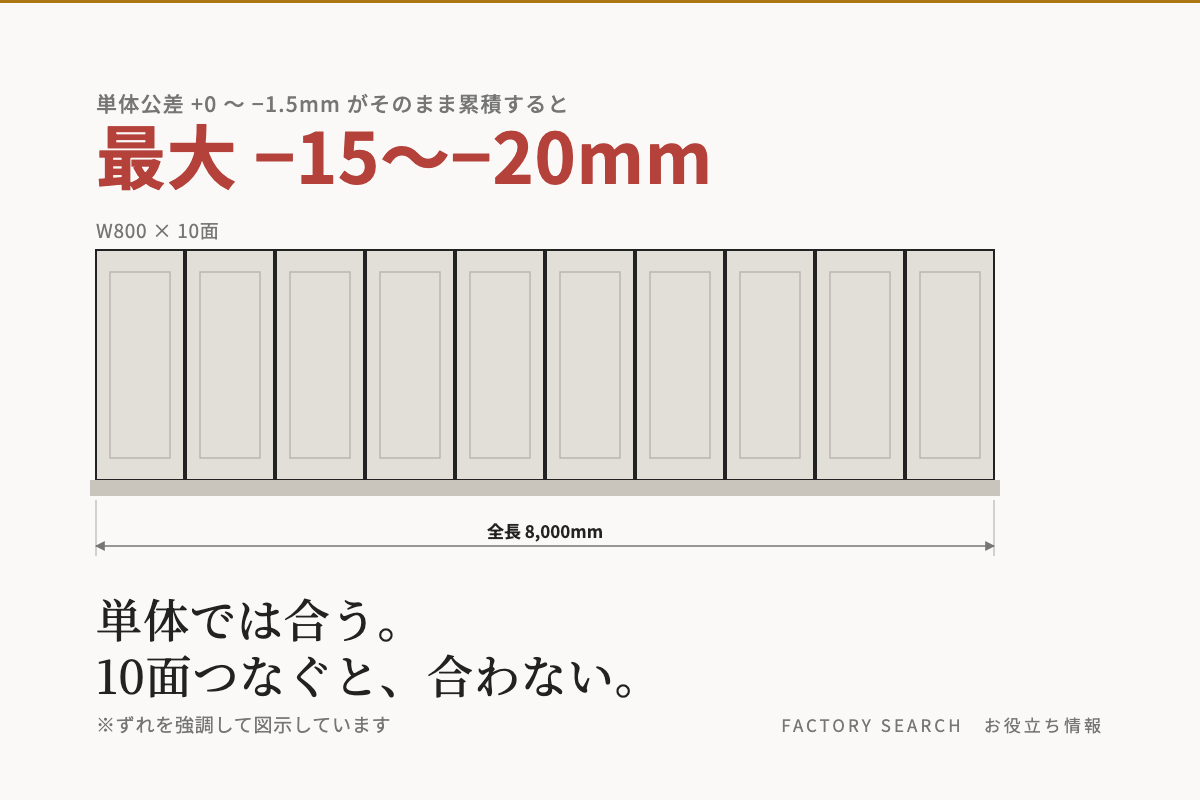
"It passed inspection individually, but the total length doesn't match when arranged on site." This is a common problem with connected panels for distribution boards and cubicles. Each panel is within tolerance, but the moment they are connected, the difference becomes too large for installation. The reason is simple: individual tolerances are directly added up. We will clarify where errors originate and where they can be absorbed.
Conclusion: Treat Individual Panel Precision and Connected Panel Precision as Separate Entities During Manufacturing
Suppose you connect 10 frames, each W800, with an individual tolerance of +0 to -1.5mm. The designed total length is 8,000mm. If each panel shifts to the lower limit of its tolerance, it results in -1.5mm × 10 panels = a maximum of -15 to -20mm. While "1.5mm is acceptable" for an individual panel, for connected panels, this difference means anchor positions will not align.
In other words, "keeping individual panels within tolerance" and "achieving the total length of connected panels" are separate tasks. To achieve the latter, connected panels must be considered from the individual panel manufacturing stage.

What you will learn from this article
- How individual tolerances accumulate in connected panels
- The 4 processes where errors can occur
- Why the total length can be off even if the outer dimensions match, if the diagonals are incorrect
- What the buyer should communicate in drawings and instructions
Where Do Errors Occur?
There isn't just one reason for the total length deviation in connected panels. They take effect sequentially.
1. Dimensions of the Material Itself
The length and angle of sides for angle steel and channel steel can vary by approximately ±1.5mm depending on the lot. JIS G 3192 also permits a tolerance of ±2.0mm for angle steel with side lengths between 50mm and less than 100mm. Even if cut according to the drawing, the assembled product will differ if the actual dimensions of the material are different.
Material tolerances are discussed in detail in "How Much Can Section Steel Dimensional Tolerances Vary?"
2. Cutting Dimensions
This is the error introduced during cutting from standard length materials. If you cut according to drawing dimensions without measuring the actual material, the deviation from point 1 will remain. If cutting dimensions are determined based on actual measurements for each lot, this error can be canceled out here.
3. Hole Position
Connected panels are joined by connecting bolts, so the hole pitch directly determines the distance between panels. If holes are drilled based only on individual drawings, the connecting holes may not align when joined, or forcing them through may cause distortion.
4. Distortion from Welding
Distortion inevitably occurs once assembled and welded. If left unaddressed, both the outer dimensions and diagonals will shift. It is assumed that this will be fully corrected in the final process.
Even if Outer Dimensions Match, Total Length Will Be Off if Diagonals Are Incorrect
This is often overlooked. Even if the width and height of each panel are as per the drawing, if the diagonals are incorrect, the frame will be skewed into a parallelogram. When skewed frames are arranged, the touching surfaces will not align perfectly, and gaps will accumulate.
Therefore, for frames intended for connected panels, it is necessary to incorporate not only outer dimensions and hole pitch but also angles and diagonals. In an actual manufacturing example where a 10-panel, 8,000mm connected panel system was kept within ±2mm total length, errors were absorbed by dividing the process into four stages: cutting precision, hole position, assembly sequence, and final distortion removal.
What is done in the 4 processes
- Cutting precision: Cutting in-house from standard length materials, determining cutting dimensions based on actual measurements for each lot.
- Hole position: Determining hole positions assuming connection for connected panels.
- Assembly sequence: Considering which order of assembly will prevent cumulative errors. This includes the relationship between the main body and the base.
- Final distortion removal: Fully removing welding distortion in the final process, finishing angles, diagonals, and total length.
What the Buyer Should Communicate
There are aspects that cannot be fully addressed by the manufacturer's efforts alone. Communicating the following at the quotation and ordering stage will reduce rework.
| What to communicate | What happens if not communicated |
|---|---|
| Whether it will be connected panels, and how many panels to connect | Manufactured based only on individual tolerances, with no consideration for accumulation |
| Connection method (bolt positions, presence/absence of splice plates) | Hole positions determined based on individual panel standards, preventing connection during assembly |
| Prioritized dimensions (total length / diagonal / hole pitch) | Not all can be prioritized simultaneously, leaving the decision to the manufacturer |
| Installation side constraints (anchor positions, gap to wall) | Tolerance distribution cannot be adjusted to site conditions |
| Presence and type of surface treatment | Dimensions change by the plating thickness, and post-treatment cannot be anticipated |
Specifically, whether "W800 x 10 panels" is communicated changes the design of cutting dimensions and assembly sequence. If only individual drawings are provided, simply adding the number of panels will change the outcome.
Summary
- Even with an individual tolerance of -1.5mm, connecting 10 panels can result in a cumulative deviation of up to -15 to -20mm.
- Errors originate from 4 points: "material dimensions," "cutting," "hole position," and "welding distortion."
- Even if outer dimensions match, the total length will be off if diagonals are incorrect. It is necessary to incorporate angles and diagonals.
- Absorption is possible through 4 processes: cutting precision, hole position, assembly sequence, and final distortion removal.
- The buyer should communicate "number of connected panels," "connection method," and "prioritized dimensions."
Frequently Asked Questions
- Q. Will connected panels align if individual tolerances are specified strictly?
- A. It will have an effect, but it's not enough. Material tolerances cannot be changed, and tightening tolerances increases unit costs. It is more realistic to design with cutting dimensions, hole positions, and assembly sequences based on connected panels, rather than just tightening individual panel tolerances.
- Q. Can't adjustments be made on-site?
- A. A few millimeters can be accommodated with slotted holes or shims, but a -15mm deviation makes installation itself impossible. On-site adjustments also directly impact lead time and labor costs.
- Q. How many panels can be accommodated?
- A. It depends on the company's equipment and welding space. Large connected panels require sufficient space to check precision while assembled, so please confirm the maximum dimensions that can be handled and the size of the welding space.
- Q. What should be considered if the panels are to be delivered in sections?
- A. Determine the division points and joining methods in advance, and build precision for each divided unit. There are cases where panels were manufactured as divided frames, so please communicate any delivery route constraints at an early stage.
Related articles
Industrial Angle Frame Manufacturing
Manufacturing of angle frames and stands for distribution boards and cubicle enclosures. E…