
Insights
What is Channel Steel (Channel)? | Size Standards and Applications of Channel Bases
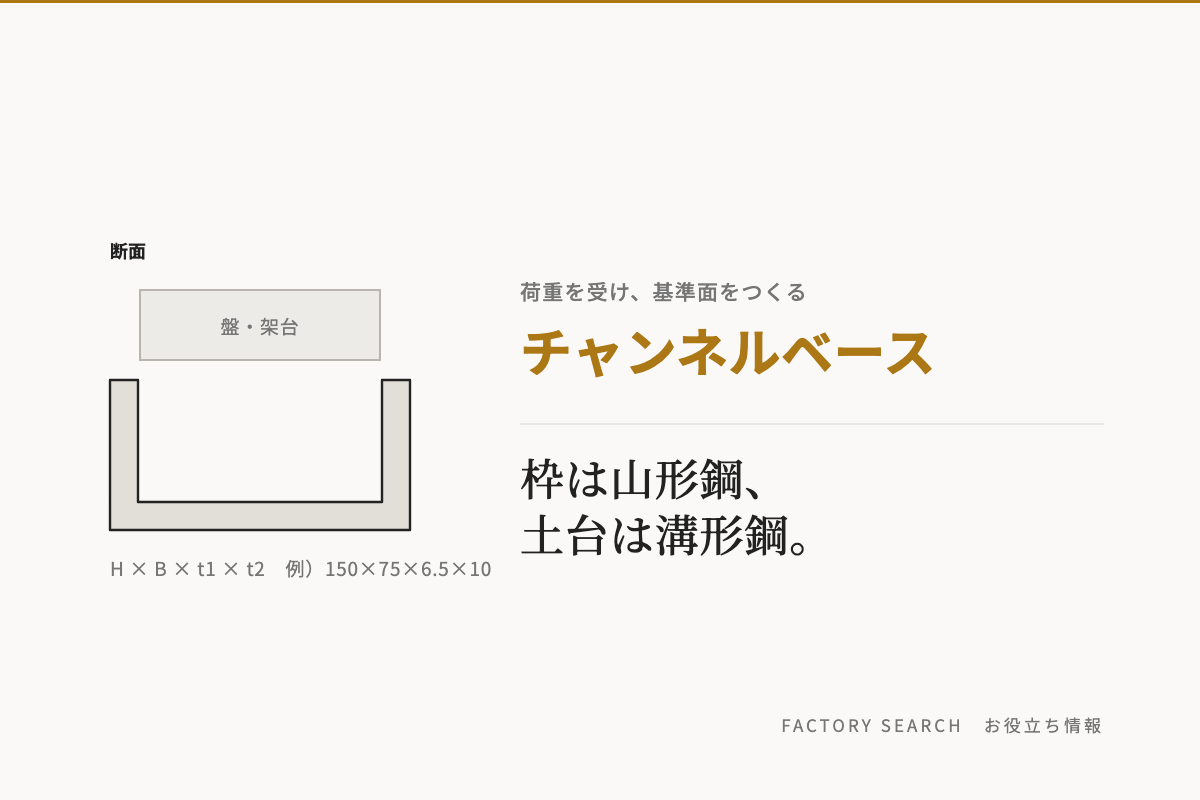
Channel steel is a structural steel with a U-shaped cross-section. Also known as "channel," it is often used as a foundation (channel base) for control panels and frames. While angle steel is used for framing, channel steel is a material that receives loads and creates a reference plane. This article organizes how to read its notation, differentiate its use from angle steel, and the precision required for bases.
Conclusion: Notation is "Height H × Width B × t1 × t2"
Channel steel has two types of plate thickness. This is because the thickness differs between the web (back part) and the flanges (protrusions on both sides). Therefore, unlike angle steel's three numbers, channel steel is represented by four numbers.

For 150×75×6.5×10, it means height 150mm, width 75mm, web thickness 6.5mm, and flange thickness 10mm.
Sizes and Applications
| Height × Width | Thickness t1 × t2 | Main Applications |
|---|---|---|
| 75×40 / 100×50 | 5×7 / 5×7.5 | Small bases |
| 125×65 / 150×75 | 6×8 / 6.5×10 | Mainstay for channel bases |
| 180×75 / 200×80 / 200×90 | 7×10.5 〜 8×13.5 | Large bases / Frames |
| 250×90 / 300×90 / 380×100 | 9×13 〜 13×16.5 | Large / Heavy objects |
Sizes are based on the standard dimensions of JIS G 3192. The actual range that can be handled depends on the company's equipment, so please check examples that publish compatible structural steel sizes.
Differentiating Use from Angle Steel
| Angle Steel (Angle) | Channel Steel (Channel) | |
|---|---|---|
| Cross-section | L-shaped. 2 surfaces | U-shaped. 3 surfaces |
| Thickness specification | 1 (t) | 2 (t1・t2) |
| Strengths | Framing. Connecting surfaces at right angles | Strong against bending. Receiving and transferring loads |
| Main roles | Enclosure frames, reinforcing materials | Channel bases, frames, girders |
| Guideline for differentiation | Parts that form a box when combined | Parts supported from below, parts spanning a distance |
For control panel enclosures, the basic combination is angle steel for the frame and channel steel for the base laid underneath. Since the base contacts the floor and bears the entire load, channel steel with a large cross-section is suitable.
Channel Bases Serve as a "Reference Plane"
The role of a base is not just to receive loads. From a precision standpoint, creating a reference plane for installation is more important.
If the base is tilted, all frames placed on it will also tilt. If the base is twisted, the diagonals of the frame will also be off. This may not be noticed individually but becomes apparent as total length misalignment when panels are arranged side by side.
Points to Check for Bases
- Flatness: Does it wobble when placed on the floor?
- Straightness: Is it warped over a long span?
- Anchor hole positions: Do they match the floor side?
- Interface with the main body: Does it provide a reference when the frame is placed on it?
Since channel steel has an asymmetrical cross-section, it is prone to bending if welding is concentrated on one side. For longer bases, assembly sequence and final distortion removal become more critical. Whether a company designs considering the relationship between the main body and the base makes a difference here.
What to Communicate When Placing an Order
| What to Communicate | Why |
|---|---|
| Weight and center of gravity of the object to be placed | Directly affects cross-section size selection |
| Span (distance between supports) | Determines deflection. Longer spans require larger cross-sections |
| Anchor positions and number | Hole positions cannot be changed later |
| Floor condition (level, presence of embedding) | Determines how much the base needs to compensate |
| Surface treatment | If plated, holes may be blocked, requiring post-treatment consideration |
Summary
- Channel steel notation uses four numbers: "Height H × Width B × Web thickness t1 × Flange thickness t2"
- The main sizes for channel bases are around 125×65 and 150×75
- The basic combination is angle steel for frames and channel steel for bases supported from below
- Bases not only receive loads but also create a reference plane for installation
- If the base tilts, all frames above it will tilt. This becomes apparent as total length misalignment in panel arrangements
- Since the cross-section is asymmetrical, welding tends to be uneven, making assembly sequence and distortion removal critical
Frequently Asked Questions
- Q. Are "channel" and "channel steel" the same thing?
- A. Yes, they are the same. "Channel steel" is the JIS name, while "channel" is the English-derived term used in the field. What is laid under a control panel is called a "channel base."
- Q. Is it different from lip channel steel (C-channel)?
- A. They are different. Lip channel steel is a lightweight structural steel made by bending thin steel plates, with the opening folded inward. This article deals with hot-rolled channel steel (JIS G 3192), which has a larger cross-section and thickness and is used for supporting heavy objects.
- Q. Can two angle steels be combined to make a base?
- A. Yes, but it increases the amount of welding and distortion. Considering the cost and effort versus cross-sectional performance, using channel steel directly is often more advantageous.
- Q. What level of flatness can be achieved for a base?
- A. It depends on the company's equipment and the distortion removal process. The result varies depending on whether there is enough space to measure a long base while assembled, so please confirm the maximum compatible dimensions and working space.
Related articles
Industrial Angle Frame Manufacturing
Manufacturing of angle frames and stands for distribution boards and cubicle enclosures. E…