
Insights
Holes Clogging in Hot-Dip Galvanizing | Post-Plating Treatment and Drain Hole Practices
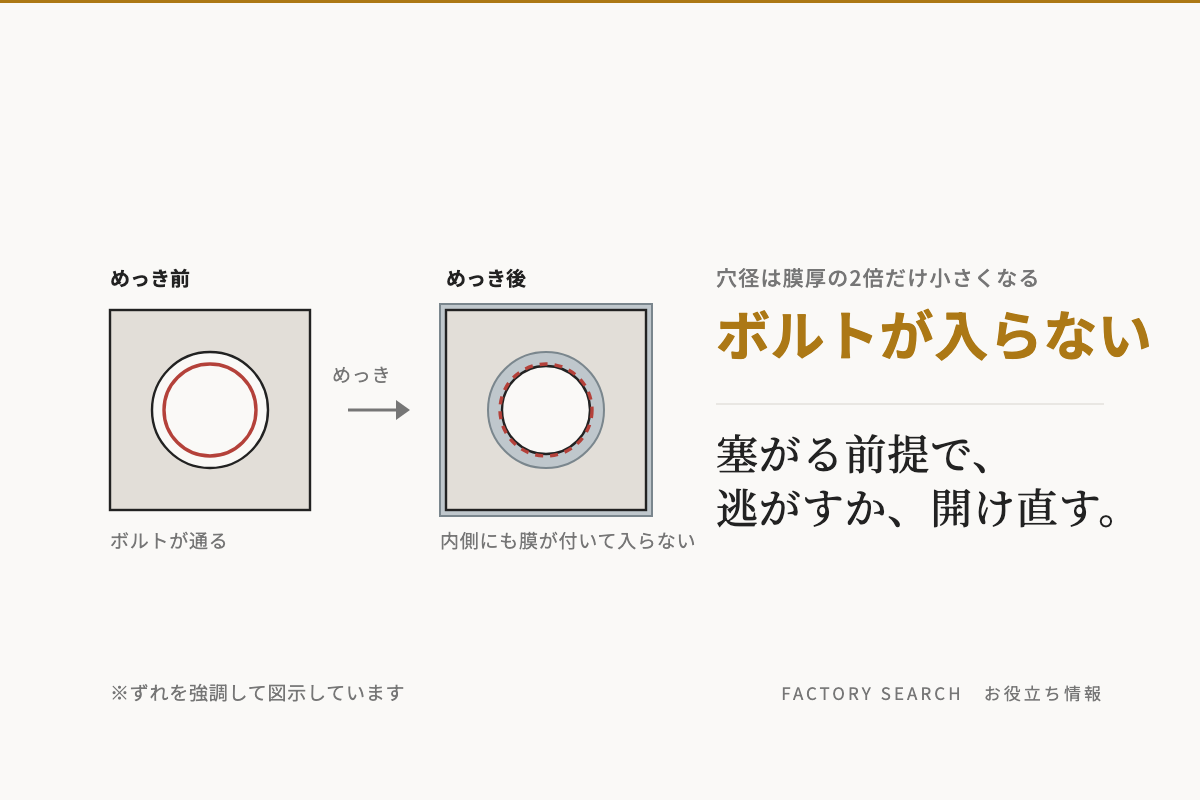
"Bolts don't fit after plating," or "Taps are clogged." These are common issues with hot-dip galvanized frames. Unlike painting, plating creates a thick film, which changes the dimensions of both holes and threads. We will clarify how holes clog, methods to prevent it, post-treatment, and what needs to be decided before placing an order.
Conclusion: Assume Clogging, Then Prevent or Re-drill Later
Hot-dip galvanizing is a process where steel is immersed in a bath of molten zinc. As a layer of zinc adheres to the surface, holes become smaller due to the film forming on the inside, and internal threads become filled, preventing bolts from being screwed in. While paint film thickness is typically tens of micrometers, hot-dip galvanizing is on a different order of magnitude.
There are only three solutions: pre-enlarging holes, re-drilling/re-tapping after plating, or masking off specific areas to avoid plating. The key is to decide which option to choose before placing an order.

What Happens During Plating
| What Happens | Impact |
|---|---|
| Through-holes become smaller | Bolts won't pass through. Slotted holes also narrow similarly |
| Internal threads become filled | Bolts cannot be screwed in. Forcing them may damage the threads |
| Drain holes clog | Zinc or water remains inside, causing corrosion or weight increase |
| Dimensions shift | Residual stress is released due to immersion in a high-temperature bath, which can cause warping or twisting |
| Drips remain on corners | Poor adhesion of mating surfaces. Affects joints in panel assemblies |
What is particularly often overlooked are drain holes. Closed-section members require a path for internal air and gas to escape when immersed in the bath, and a path for zinc to drain when removed. Without these, the plating company will reject the part, stating it cannot be processed as is. For designs using closed sections, please confirm the feasibility of plating beforehand.
Three Methods to Prevent Clogging
1. Pre-enlarge Holes
This method involves enlarging hole diameters in anticipation of the film thickness. It is the cheapest option as it requires no additional machining, but it increases play, making it unsuitable for holes that also serve for positioning. This is a difficult choice for areas requiring precision, such as connection holes in panel assemblies.
2. Re-drill / Re-tap After Plating
After plating, holes are re-drilled to the specified dimensions, and internal threads are re-tapped. This method is for holes requiring precision. However, the machined surface will expose the base material, so if corrosion protection is needed, consider additional treatments like touch-up painting.
Whether a company can handle this post-treatment in-house varies. Some examples include integrated services for re-drilling clogged holes, re-tapping, and filling drain holes, while other companies simply deliver parts as they return from the plating shop. You must inquire about this beforehand.
3. Do Not Plate Specific Areas
This method involves masking to leave the base material exposed, or making it a separate component to be assembled after plating. From a corrosion protection standpoint, this is a weak point, so it is limited to indoor areas or parts that can be painted later.
What to Decide Before Placing an Order
| What to Decide | What Happens If Not Decided |
|---|---|
| Which holes/threads require precision | All will be enlarged, causing play, or all will require post-processing, increasing costs |
| Who will perform post-plating treatment | Parts will be delivered as returned from plating, requiring on-site tapping |
| Location of drain holes and whether to fill them later | Parts will be rejected by the plating company, or holes will remain visible |
| Tolerance for dimensional shifts and scope of rework | Parts will be delivered warped, causing difficulties during installation |
| Treatment of drips on mating surfaces | Joints will not adhere tightly, leading to accumulated gaps in panel assemblies |
The issue of dimensional shifts is related to residual stress from welding distortion. Stresses suppressed by welding are released by the heat of the plating bath, causing movement. For frames intended for plating, an assembly sequence that accounts for this movement is necessary.
Summary
- Hot-dip galvanizing creates a thick film, narrowing holes from the inside and filling internal threads.
- There are three methods to prevent clogging: "pre-enlarge holes," "re-drill/re-tap after plating," and "do not plate specific areas."
- Holes requiring precision should be post-machined. Holes where play is acceptable should be pre-enlarged, using different approaches as needed.
- Closed sections will not be accepted for plating without drain holes.
- Residual stress can be released by the heat of the bath, causing dimensional shifts.
- Whether post-treatment can be done in-house varies by company, so confirm before placing an order.
Frequently Asked Questions
- Q. How much should holes be enlarged?
- A. Film thickness varies depending on the material's plate thickness and plating conditions, so a uniform answer cannot be given. Please confirm the expected film thickness for that material with the plating company and the manufacturing company before deciding. For holes that also serve for positioning, it is more reliable not to enlarge them and to perform post-machining.
- Q. Will the same problem occur with baked coating?
- A. Paint film thickness is thin, so the problem is not as severe as with plating. However, if paint gets into the threaded parts, screwing will become difficult. Even with painting, masking instructions are necessary.
- Q. Does re-tapping after plating reduce corrosion resistance?
- A. The machined surface will expose the base material. If the area is hidden by a tightened bolt, it often poses no practical problem, but for critical outdoor parts, treat it with zinc-based touch-up paint or similar. Please consult by explaining the usage environment.
- Q. Which should I choose, plating or painting?
- A. For outdoor and long-term corrosion protection, hot-dip galvanizing is standard. If color and finish are desired, baked coating is generally preferred. There are also cases where different parts are treated differently, such as painting for outdoor cubicles and plating for frames and bases.
Related articles
Industrial Angle Frame Manufacturing
Manufacturing of angle frames and stands for distribution boards and cubicle enclosures. E…