

Evolving through challenges,
Refining our quality.
With skills and quality cultivated through industrial blade machining,
We aim to be the company our customers value most.
-
Komori Seiki Co., Ltd.
- Machine parts, die/mold parts, jig/tooling and gauge design and manufacturing, industrial cutting tools, precision assembly
Naoki Hattori
- Prefecture
- Gifu
- Business Activities
- Machine parts, die/mold parts, jig/tooling and gauge design and manufacturing, industrial cutting tools, precision assembly
- Company Name
- Komori Seiki Co., Ltd.
- Representative Name
- Naoki Hattori
- Location
-
〒504-0927
7-1-11, Kamitocho, Kakamigahara-shi, Gifu, Japan
- Phone Number
- 058-382-4181
- Website
Factory Stories
Precision Machining for Small-Lot, High-Mix Production: Bringing Drawings to Life
Komori Seiki Co., Ltd. performs precision machining of metal products.
Based on drawings provided by customers, it machines high-precision, difficult-to-machine, high-hardness parts one by one.
Its current main focus is producing individual parts in small-lot, high-mix production. Lot sizes start at one piece and are at most about 100 pieces.
“About 35% of our products are repeat orders; most are one-off.”
So says Naoki Hattori, the third-generation president.
“Actually, until about 25 years ago, we also handled mass production machining.”

Three People’s Manufacturing Story, Starting as a Door-to-Door Supplier
Komori Seiki Co., Ltd. was founded in 1972 by Hiroshi Komori, Naoki's maternal grandfather.
At that time, he visited customers, listened to their needs, and procured and delivered what they required.
To respond to machining inquiries received through this work, he began machining in a small rented factory.
This founding period was supported by Hiroshi Komori, who managed the business; Ozawa, a Komori relative responsible for technical work; and Tetsuo Hattori, Naoki's father, who was responsible for sales and would later become president.
“At that time, my father had not yet married my mother, so I think he was the first employee to join as a complete outsider.”
The starting point for the company’s machining business was industrial blades, which enabled Ozawa to apply his expertise in grinding. Initially, the company added cutting edges to customer-supplied products before delivering them.
It subsequently expanded its business by adding machine tools such as milling machines and drill presses, enabling it to perform preliminary machining.
Precision and Functionality Refined Through Wire Harness Blades
A major turning point came when the company received orders for blades used to process electrical wires and wire harnesses for automobiles and other applications.
Two semicircular blades are combined to form a perfect circle, creating a structure that cuts only the insulation around a wire while leaving the copper conductor intact. A misalignment of 1/100 mm can lead to defects.
“Because blades are thin, they warp significantly when hardened. The skill we refined through determining how to correct that warping and maintain accuracy was distortion correction.”
Where to grind and where to apply pressure: distortion correction requires craftsmen’s skills that cannot be determined by machines alone. This is the core expertise of Komori Seiki that has been passed down to the present day.
“In addition to improving precision, we improved functionality by devising how to form the cutting edges, and the number of shots increased to more than 1.8 times that of similar products from other companies, earning us a good reputation.”
This challenge of producing difficult blades refined Komori Seiki’s manufacturing capabilities in areas including precision, distortion correction, and functionality.

From the Crisis of Mass-Production Dependence to a System for Small-Lot, High-Mix Production
Building on its refined precision and technical capabilities, Komori Seiki also grew significantly through mass production.
Its high-precision jigs were recognized for significantly reducing customers’ defect rates, and by the 1990s, jig machining for semiconductor manufacturing equipment accounted for 70–80% of sales. Sales at that time reportedly reached about four times their current level.
In 1998, shortly after Tetsuo Hattori became president, the IT bubble burst. Work from a major customer that accounted for most of the company’s sales came to a halt, and the company faced a major crisis.
“When 70% of sales depend on one customer, the company cannot operate.”
Tetsuo, who had just become president, made the painful decision to lay off half the workforce. He then made a major shift from mass production to small-lot, high-mix production.
From then on, Komori Seiki began accepting prototypes and difficult-to-machine parts that other companies would refuse.
Along with the shift from mass production to small-lot, high-mix production, its inspection system also changed significantly. Unlike mass production, which involves making large quantities of the same product, individual parts and small lots require inspection of every part and every point, not just sampling inspection.
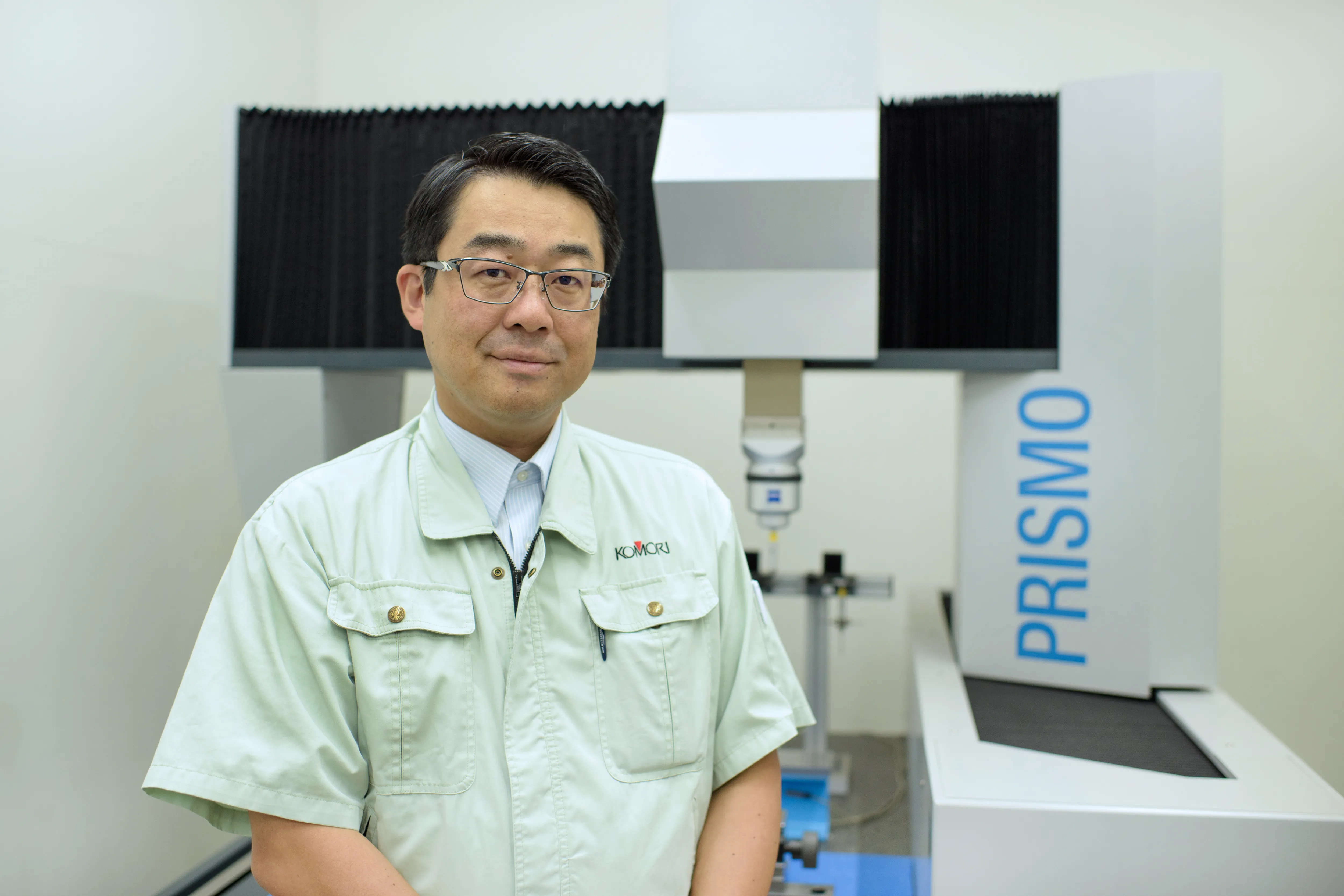
The company therefore placed importance on the ability to measure at a level of precision one step higher than the machining precision.
“If machining accuracy is 1/1,000 and measurement is at the same level, you cannot determine the correct value. That is why inspection requires accuracy of 1/10,000.”
Has the machined product truly been finished as intended? Where does its position fall within a 1-micron tolerance range? Quality can be assured only when those questions can be answered.
For this purpose, Komori Seiki established a temperature-controlled inspection room maintained at 20℃±0.5℃, refining machining and measurement together.
As it overcame its crisis of mass-production dependence and moved toward small-lot, high-mix production, the company improved not only its machining technology but also the inspection system that supports quality.

The Third Generation’s Drive for Multi-Skilling to Support New Challenges
Naoki Hattori joined Komori Seiki in 2013, changing careers after working at a law firm.
He had little knowledge of machining and, when he joined the company, gained experience in measurement, quality control, and sales while learning from younger employees.
When Naoki became the third-generation president in 2019, the COVID-19 pandemic struck shortly afterward. At a time when not everyone could come to work, Naoki focused on multi-skilling.
Under the previous generations, the policy had been to develop specialists for each process. While this produced strong technical capabilities, work would stop if the person responsible was absent.
There was also intense pressure on the factory floor: “Failure is not an option.” Even a product that had taken considerable time to machine in earlier processes could be ruined by removing just slightly too much material in the final process.
In such a tense environment, it is not easy to take on new machines or processes.
“If you are concerned, you can make one extra. If you need tools, buy them. If you fail, I will go and explain it to the customer, so let’s try it first.”
Naoki offered these words in an effort to ease the pressure on the factory floor as much as possible. He believed that his role as a manager was to create an environment in which employees could take on challenges without fear.
When a failure occurred, he considered its cause together with the factory-floor team to prevent the same failure from happening again. Through these efforts, employees gradually began to work across process boundaries.
Now, when a process becomes congested, they can consider whether it can be handled by another machine or another person.
Becoming the Company Customers Value Most
The challenges Naoki faced after COVID-19 were not limited to multi-skilling on the factory floor.
The sales department’s general manager and section chief resigned in succession, followed by retirement and resignations among younger employees.
Naoki reportedly took everything on himself, thinking, “I have to do everything myself.”
At that time, fellow business owners reached out to him. Encouraged to “go out and consult others at times like this,” he listened to people with similar experiences. That was when Naoki learned to rely on others.
“I learned, in the true sense of the word, how to rely on others.”
Currently, Naoki makes every effort to communicate the company’s situation and the roles expected of employees. He also discloses financial-statement-based figures, including operating profit and break-even points.
“There is no point in hiding things. Unless you speak openly and seriously, others will not act.”
He also clarifies each employee’s role and confirms it in daily one-on-one meetings.
This is Naoki’s way of moving forward together by relying on others, rather than doing everything himself.
What Naoki aims for is to become the company customers value most.
“It is difficult to be number one in sales or size. But I believe we can become the company that is number one in some respect for our customers.”
The company customers can rely on most, the company that is easiest to consult, the company most willing to take on challenges… He also asks every employee to consider what kind of number one they want to become.
Komori Seiki began by visiting customers and responding to their needs, then overcame crises to transition to small-lot, high-mix production. Its manufacturing will continue to be refined through human skills and management that trusts people.

