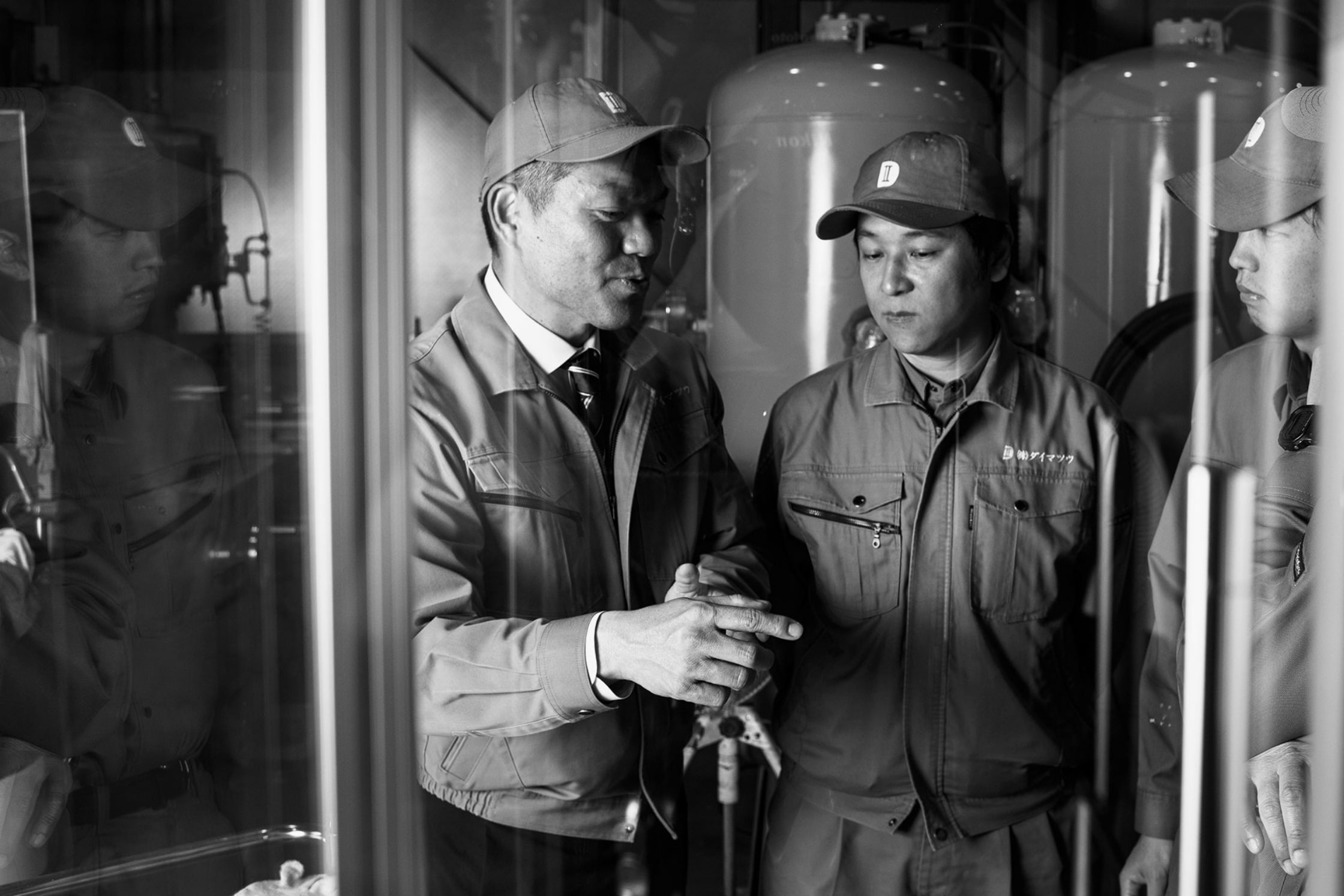
Our team's power to challenge drawings.Planning and responsiveness,driven by customer needs, to create machinery.
-
Daimatsu Co., Ltd.
- Design, manufacturing, and sales of various machinery and equipment.
Tomoya Hiramatsu
- Prefecture
- Aichi
- Business Activities
- Design, manufacturing, and sales of various machinery and equipment.
- Company Name
- Daimatsu Co., Ltd.
- Representative Name
- Tomoya Hiramatsu
- Location
-
〒444-1213
175, Yochi, Higashibata-cho, Anjo-shi, Aichi, Japan
- Phone Number
- 0566-92-5921
- Website
Factory Stories
Founding the Company Driven by a Sense of Purpose
Daimatsu Co., Ltd., which designs and manufactures mechanical equipment, was founded in 1987 by Tomoya Hiramatsu's father.
It began when Tomoya's grandfather, who was a fisherman, used compensation money from land reclamation due to industrialization to build an ironworks.
"My father is the eighth of nine siblings. Perhaps my grandfather had foresight, thinking that fishing alone would not be sustainable in the future, so he had his seventh, eighth, and ninth children run an ironworks for parts processing."
While my father was working as a salesperson and craftsman at the ironworks, an acquaintance of his, who was in production engineering at our current main client, asked him to build specialized equipment for a production line.
"He said it was interesting to build machines through trial and error, even with failures. He mentioned that even with failures and personal responsibility, he felt a great sense of accomplishment and fulfillment."
Thus, his father became independent from his brother and started a company for the design and manufacturing of mechanical equipment.
"Initially, the company name was Omatsu Seikou. Perhaps he chose Omatsu from Hiramatsu with the desire to become a large company? However, when we did business with the US, Omatsu Seikou, being entirely in Kanji, was mistaken for a Chinese company. So, when we incorporated, we changed it to Katakana. We thought Katakana would clearly identify it as a Japanese company. It became 'Daimatsu' as the second chapter of Omatsu Seikou."
Transition from a Systems Company
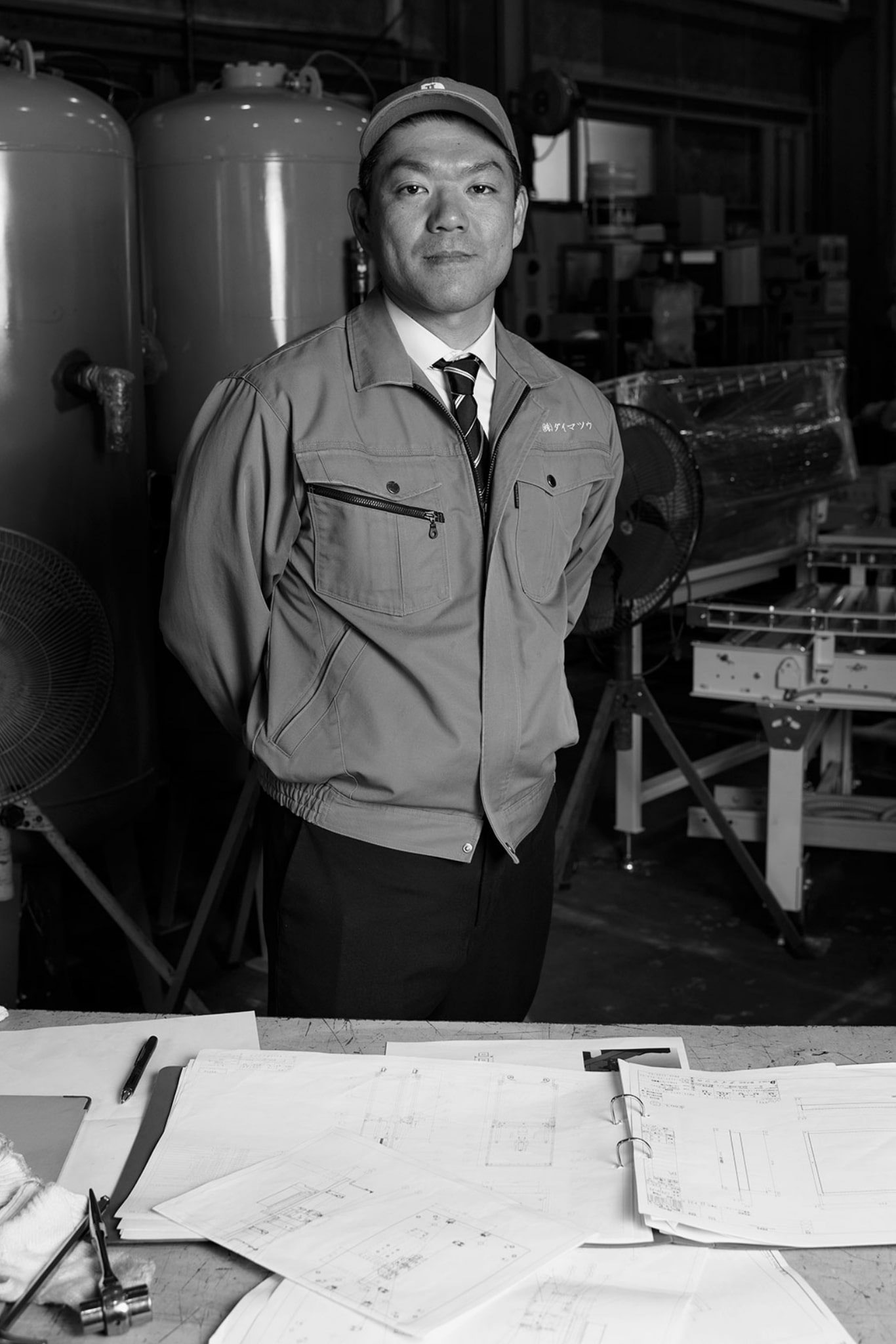
The direct reason Tomoya joined Daimatsu in 2008 was his father's illness.
"When I was a child, I never thought about taking over the business. I disliked this job because I imagined it had no holidays, was dirty, and smelled bad."
After graduating from university, Tomoya joined a systems company. However, since his two older brothers had pursued different paths, he decided to take over Daimatsu, realizing he was the only one left.
"As I thought about various things, I realized that system development is about realizing customers' 'I want to do this' through programming, and my father's work does the same thing with machines."
Furthermore, he felt this job had future potential. He believed that factory automation would continue without stopping, and automation would further advance due to labor shortages caused by the declining birth rate.
He also considered that, just as he himself hesitated about business succession, some factories might not be inherited. He predicted that if competitors decreased, work would increase.
Customers' 'We want to do this'
is the Starting Point
"We want to be the first company customers consult. In fact, currently, when customers have something they want to achieve, they consult us first."
And if it's outside Daimatsu's scope of work, we introduce companies that specialize in that particular task.
This is because Daimatsu's work starts with customers' needs, such as 'we want to do this' or 'we want to achieve this.' Daimatsu's strength lies in listening to customer needs and providing what is necessary.
"We don't have any special technology that surpasses other companies. However, we believe our planning ability to fulfill needs is high."
This planning ability leads to trust, where customers feel they can get good ideas by consulting us.
The Ability of Each Employee to Think and Act
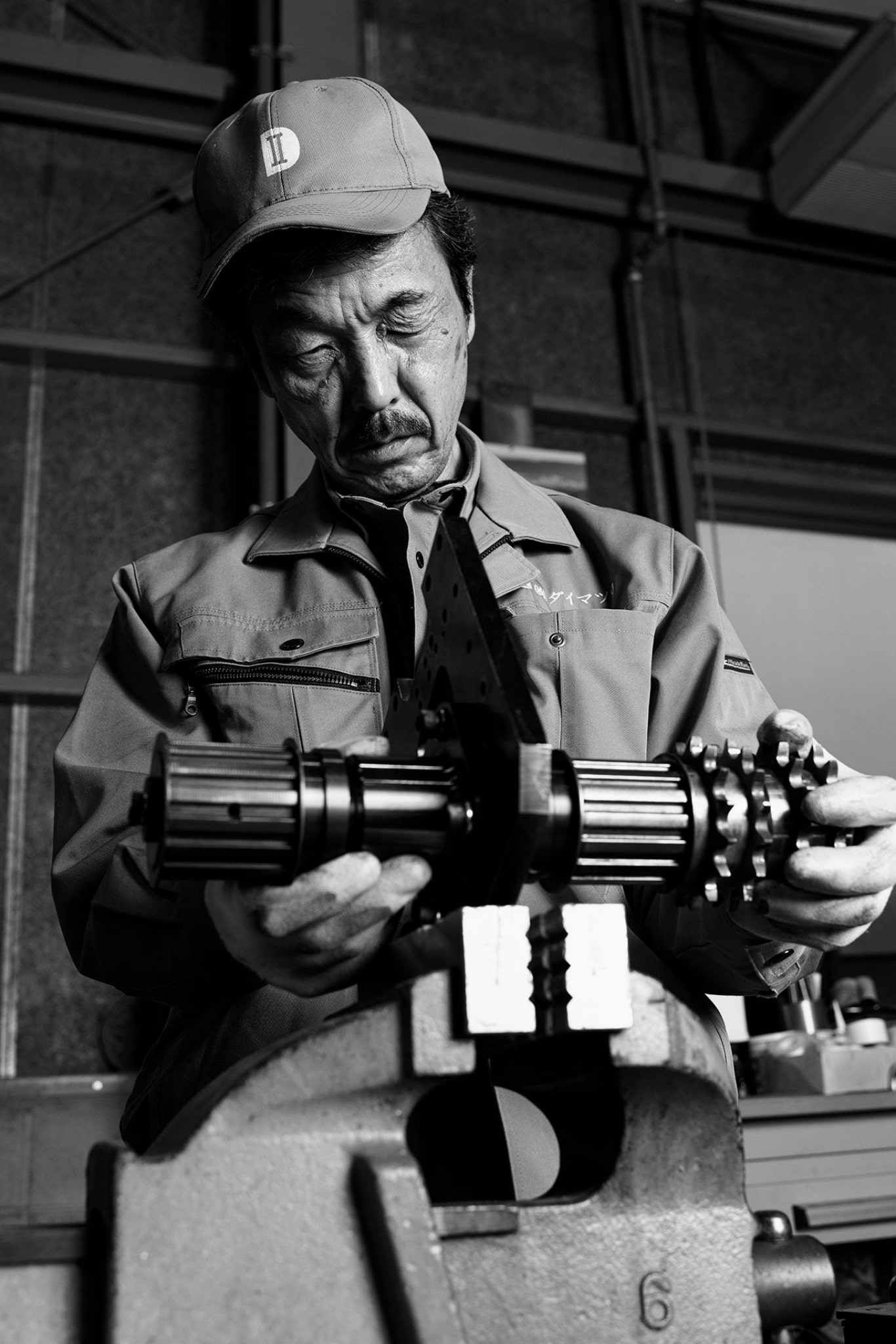
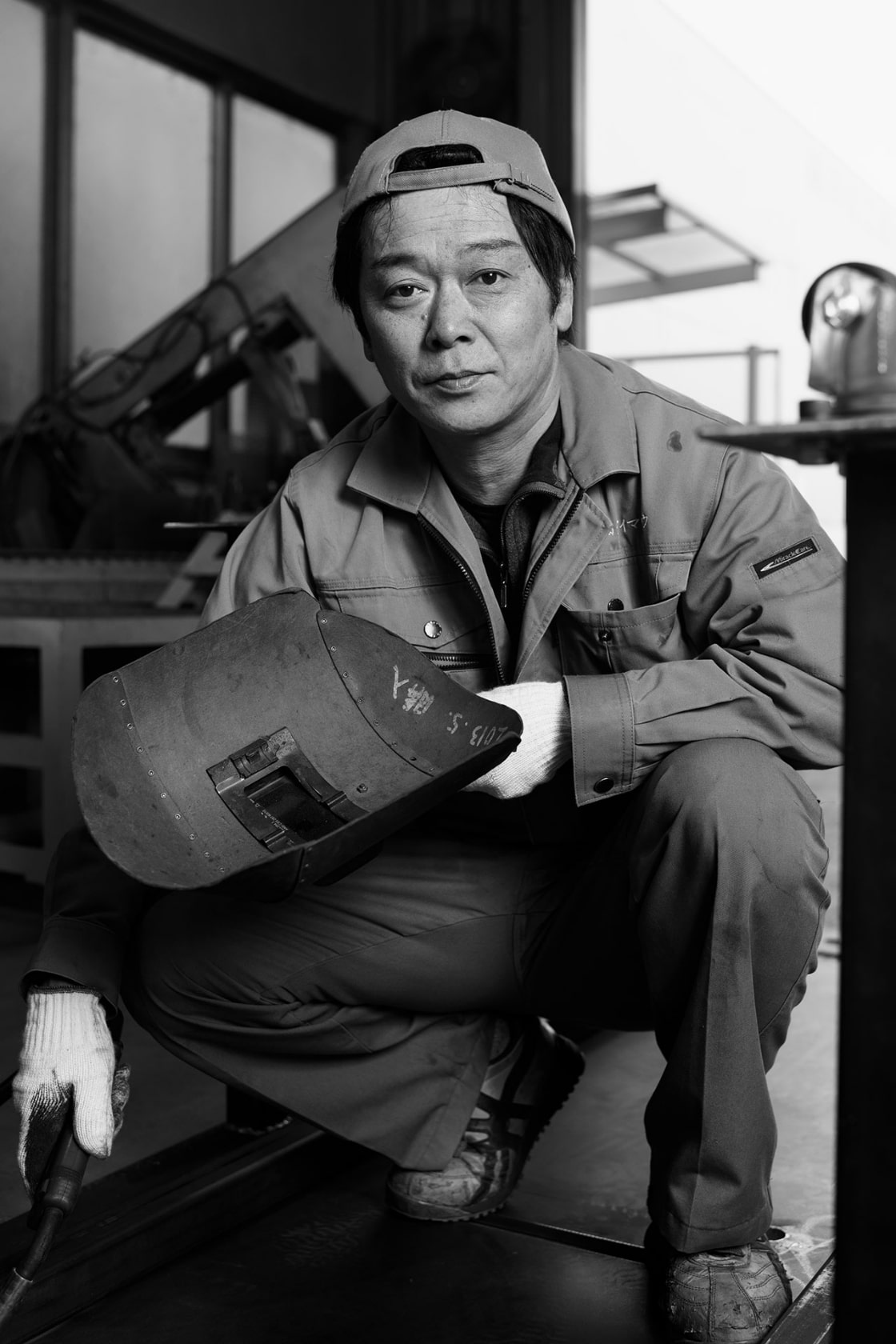
Tomoya says that what's remarkable about Daimatsu's employees is that they "don't just build exactly according to drawings."
This doesn't mean employees arbitrarily ignore drawings and proceed with work.
"For example, they might suggest, 'Since this part is used for this specific section of the machine, we can lower the precision to reduce costs,' or 'If we want to improve quality, this part should have higher precision.'"
They don't just work according to drawings; they can make proposals precisely because they are well-versed in machinery and understand its purpose.
Of course, not all employees can do this from the beginning.
They are creating a culture to train employees by passing on skills and knowledge.
As one such initiative, Tomoya created a personnel evaluation system.
"He said, 'We subdivided evaluation items into 589 categories, such as understanding dimensions from assembly drawings, drilling holes in flat plates from drawings, or being able to greet people.'"
This allows employees to clearly understand what they are being evaluated on and what they currently lack.
"Since I am not the founding president, I verbalized all the technical knowledge. I believe my experience at a systems company is useful here."
Expertise in Handling Short Lead Times
One reason customers choose Daimatsu is the trust in our ability to meet deadlines.
"Both sales and the factory floor can immediately visualize how many days a partner company's work will take and how long each process will take to manufacture this machine."
It's not easy to visualize deadlines when processes, suppliers, and their respective lead times vary.
"This might be because we were trained through the work with our current main client."
Our current main client is involved in wheel manufacturing and tire assembly. In the development of new car models, the decision on tires and wheels is made at the latest stage. Therefore, the period from specification finalization to production line startup is short. Daimatsu has consistently met these deadlines.
Production cannot start without the machinery. Because we have played this crucial role, we have accumulated expertise in meeting deadlines.
In-house Handling from Design to Processing
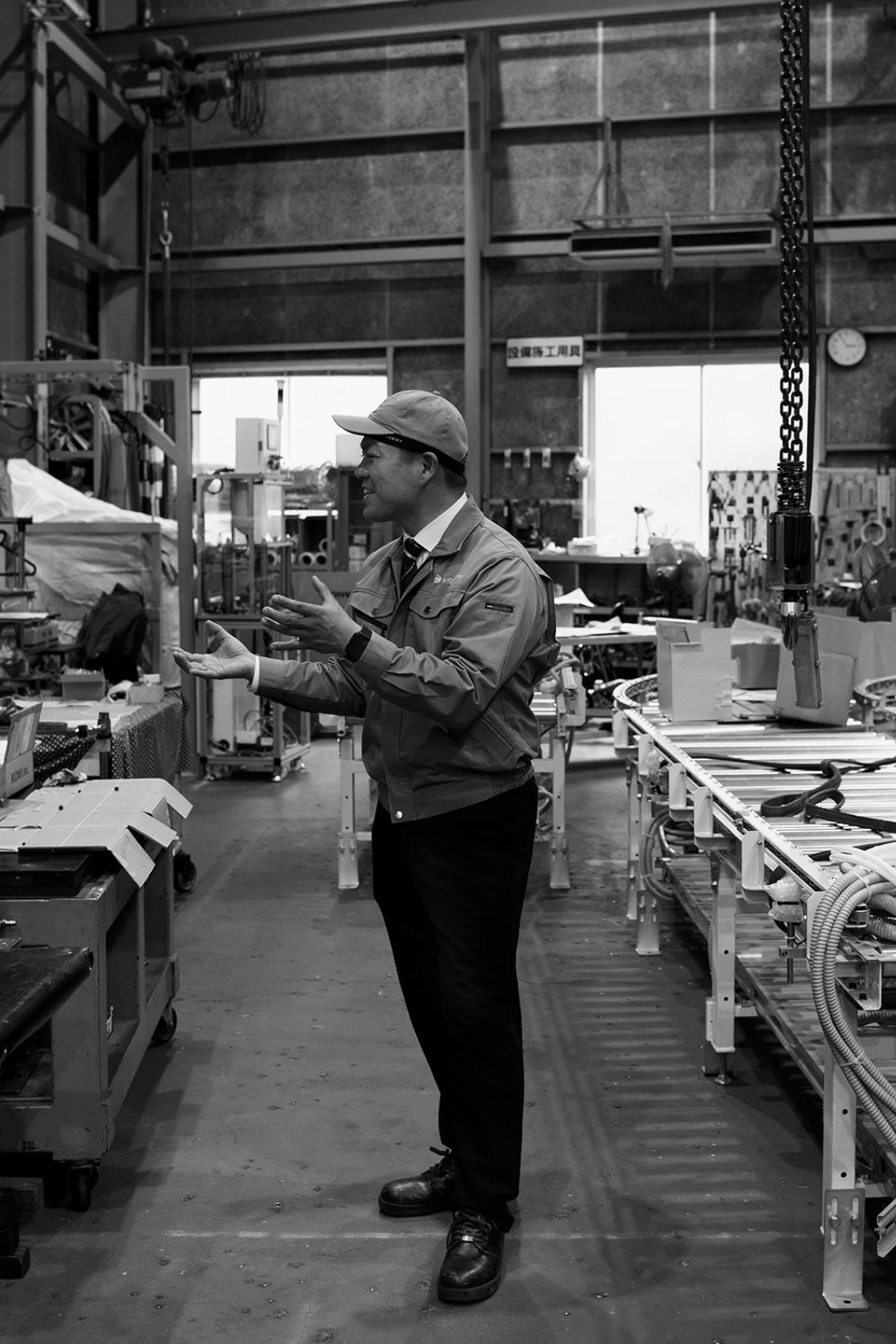
"Because we can handle all processes from design to processing in-house, we can meet various customer needs, including delivery times."
Handling all processes in-house is costly. Nevertheless, we maintain this system to continue meeting customer needs in the future.
"We decided to maintain a system where all processes can be handled to leverage Daimatsu's strengths. Since we have the capability to produce parts in-house, we can respond quickly to customer requests."
To maintain this system, Daimatsu is cross-training its employees.
This allows the 589 personnel evaluation items to be utilized, enabling employees to acquire a broad perspective, self-reliance, and high-level skills.
Bringing Mikawa's Manufacturing to the World
Tomoya recalls seeing on TV about 15 years ago that the skills of a turning craftsman in Ota Ward, Tokyo, were highly praised. It was said that they could detect a difference of 0.01mm by touch.
When he mentioned this to an employee in charge of turning within the company, he was told, "That's normal to be able to do," and "If you can't do that, you can't call yourself a turning craftsman."
"Our company's technology is not exceptionally superior compared to other companies in this region. Yet, they say that the kind of skills that amaze people on TV are normal here. This region, where technology has been refined at the heart of Toyota Motor Corporation, possesses even more incredible manufacturing technologies. And there must be places that seek these technologies."
Tomoya says he wants to promote Mikawa's manufacturing to a wider global audience.
"While I'm not yet sure what role Daimatsu can play in that, I hope to use what our company is doing as a role model and contribute to manufacturing in the Mikawa region."
Daimatsu's corporate philosophy is "A company where everyone can smile together."
"Together" means with customers, with employees, with partner companies, with the local community, and with fellow manufacturing professionals.
It is exciting to see what kind of third chapter Daimatsu, which is weaving its second chapter after Omatsu Seikou's first, will present together with the Mikawa region.
Daimatsu Co., Ltd.
- FACTORY SEARCH RADIO
-
-